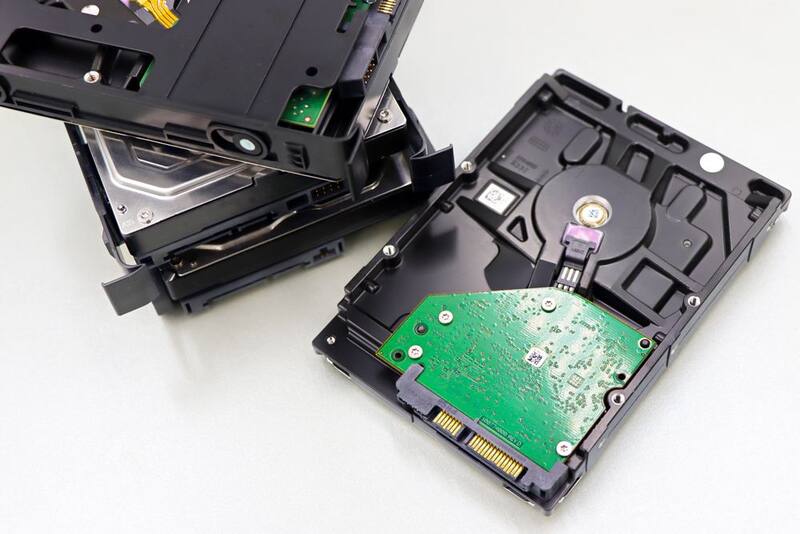
You open the laptop and something is off. The trackpad has stopped clicking properly, or it sits slightly raised. The base does not sit flat on the table any more. The lid will not close square.
That is almost always a swollen battery, and it is the one thing in this whole business that we would ask you to take seriously today rather than next month.
What is happening inside
Lithium-ion cells age. As they do, a slow chemical reaction produces gas inside the sealed pouch. In a healthy cell this is negligible. In a cell that has been through a lot of charge cycles, or has sat at full charge in a hot room for years, or has a manufacturing defect, the gas builds up faster than the pouch can take.
The pouch has nowhere to vent, so it inflates. That is the swelling you are seeing, and it is why the case around it starts to deform.
The gas itself is flammable. The bigger risk is what happens if the cell is punctured or crushed: the layers inside short against each other, the temperature climbs fast, and lithium-ion cells in that state produce their own oxygen. That is thermal runaway, and it is why a lithium fire is difficult to put out. Smothering does not work the way it does on a normal fire.
None of which means your laptop is about to explode. A swollen battery is usually stable if it is left alone. It stops being stable when someone presses on it, drops it, or puts it somewhere hot.
What to do right now
In order.
- Stop charging it. Unplug it and leave it unplugged. Charging a swollen cell makes the problem worse.
- Shut it down. Not sleep. Off.
- Move it somewhere sensible. A hard surface, away from paper, curtains, fabric and anything else that burns. A tiled floor, a balcony out of direct sun, a metal shelf. Not on a bed, not in a bag, not in a cupboard full of clothes.
- Keep it cool. Room temperature or below. Not a car in the afternoon. A car parked in the sun in Hyderabad in May gets hot enough to matter.
- Leave it alone. Do not press the bulge to see how soft it is. Everybody wants to. Do not.
What not to do
These come up often enough to be worth spelling out.
- Do not puncture it. Not with a screwdriver, not with scissors, not to let the gas out. There is no safe version of this.
- Do not put it in the fridge or freezer. This advice circulates and it is wrong. Condensation adds a short circuit risk and the cold does nothing useful.
- Do not put it in the household bin. A bin lorry compacts its load. A compacted lithium cell is exactly the crush-and-short scenario, and waste truck fires from discarded batteries are common enough that operators plan for them.
- Do not throw it in water. Lithium and water is a reaction, not a solution.
- Do not keep using the laptop on mains power. Tempting, because it often still works with the battery in. The battery is still in there getting warm.
Removing it yourself, or not
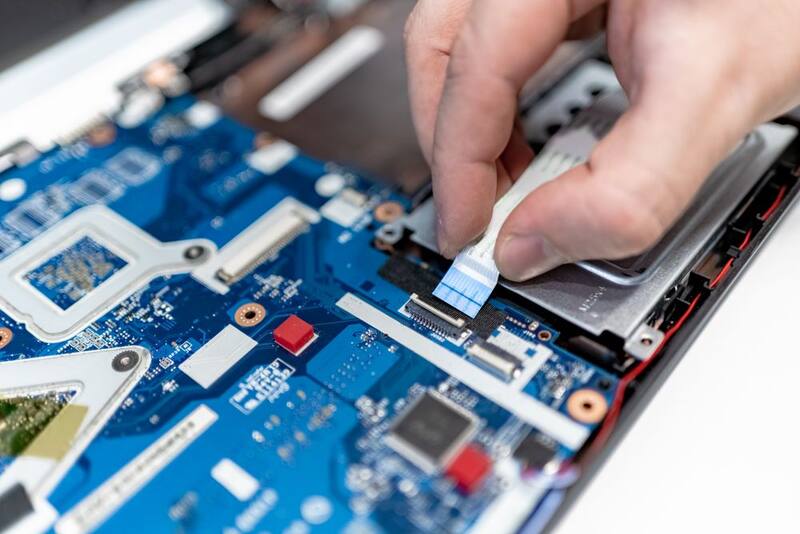
On an older laptop with a battery that clips out from underneath, taking it out is straightforward. Slide the catches, lift it out, put it somewhere cool and hard. Do not squeeze it while you are lifting.
On a modern laptop the battery is inside, usually screwed down, and sometimes glued. If it is glued and swollen, leave it. Prising a swollen pouch off adhesive with a metal tool is how punctures happen. This is a good moment to let someone else deal with it.
Either way, if the machine is going to be collected anyway, there is no need for you to take the battery out at all. Tell us when you book and we will handle it.
The same applies to more than laptops
Anything with a lithium-ion cell can do this, and some of them matter more than a laptop.
- Phones. A swollen phone battery pushes the screen away from the frame. If you can see a gap around the edge of the display, that is the reason.
- Power banks. Common offenders, because cheap ones use cheap cells and they live in hot bags.
- E-scooter and e-bike packs. These carry far more energy than a laptop battery and a failure is proportionally worse. If a pack is swollen, damaged, or has been in a crash, stop charging it, move it away from the building, and get it collected. Do not charge it indoors overnight while you decide.
- Vapes and toys. Small, ignored, and thrown in bins constantly.
Why these should not go in the bin
Beyond the fire risk, there is the material. A lithium-ion cell contains lithium, cobalt, nickel and copper. India imports all four. A battery in a landfill is those materials gone, plus a leaching problem where it sits.
Recovering them is the direction this industry has to move in, and it is the part of the business we are building towards. We are not a battery recycling plant today and we will not pretend to be one. What we do now is collect batteries safely so they are not sitting in a drawer or going out with the household waste.
Getting one collected
We collect lithium-ion batteries from phones, laptops, power banks and light electric vehicles, in Hyderabad and Bengaluru. Battery prices are quoted after we have seen the pack, because condition changes everything.
Tell us when you book that a battery is swollen or damaged. That is not a reason for us to refuse it. It means we bring the right container and handle it separately, and it means our collector is not surprised at your door.
Book at scrapwise.in or message +91 99931 99945. If something is hot to the touch, hissing, or giving off a sharp chemical smell, do not wait for a pickup slot. Get people away from it and call the fire service.